Jiangxi Daishing POF Co.,Ltd
Home> News> Types of Optical Fiber

Types of Optical Fiber

June 24, 2021
Types of Optical fiber

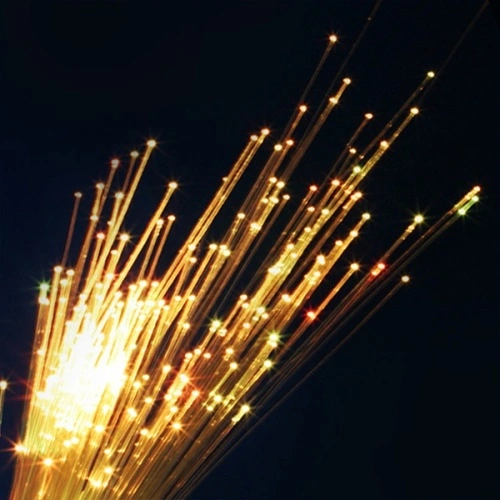
End-emitting Fiber
End-emitting fiber is generally a step-index multimode fiber with a large transparent core that transmits the light and thin transparent cladding that traps the light in the core in an optical process called [total internal reflection." The core is large in comparison to the thin cladding as that makes it more efficient in coupling light from the illuminator. The cladding does not transmit light, so any light coupled into the cladding will not be transmitted by the fiber.
End-emitting fibers are generally made from plastic as it can be made in larger sizes than glass and is less expensive and easier to install. Plastic Optic Fiber (POF) is made in sizes from 0.1 to 20 mm in diameter. Glass fibers are generally made in much smaller sizes (hair thin, about 50-150 microns or 0.05 to 0.15 mm) and bundled together to make larger diameter cables.
The choice of core and cladding materials determines the angle of light rays accepted from sources and transmitted by the fiber (called modes), defined by a specification called numerical aperture(NA). The light will exit the fiber in a cone that shows the size of the NA with larger NA having a wider output cone of illumination. Higher NA fibers also couple light from sources more efficiently, as it will capture light at higher angles emitted by the source. Typical fibers have acceptance cones of 30-60 degrees, corresponding to NAs of 0.3-0.6. When optics are used to focus the light emitted from the fiber, the NA of the fiber must be known to choose appropriate optics.

Side emitting optical fiber
Side-emitting fiber is basically similar to end-emitting fiber except the core/cladding boundary is designed to be slightly inefficient. Instead of trapping all the light in the core, the boundary is rough and some light is scattered into the cladding where it becomes visible. By careful design, the fiber can have a smooth glow that looks much like a neon light tube. Smaller edge-emitting fibers have been woven into tapes that emit light in a band.
Since much of the light is lost by the edge-emission along the fiber, edge-emitting fiber has high attenuation. This may limit the lengths of edge-emitting fiber that can be used. This can be alleviated by illuminating the fiber from both ends by using two Illuminators or looping the fiber back around to the same illuminator, or using reflective end caps to send excess light back up the fiber from the far end.

Contact Us

Author:

Mr. Wesley Wang

Phone/WhatsApp:

8618607063011

Popular Products
Company News
You may also like
Related Information
Why use Fiber Optic Lighting

Using fiber for remote lighting has many advantages, some of which are more important for special types of applications than others. Characteristics: Flexible transmission for fiber optic...

Related Categories

Email to this supplier

Subject:
Email:
Message:

Your message must be betwwen 20-8000 characters

Contact Us

Author:

Mr. Wesley Wang

Phone/WhatsApp:

8618607063011

Popular Products
Company News
We will contact you immediately

Fill in more information so that we can get in touch with you faster

Privacy statement: Your privacy is very important to Us. Our company promises not to disclose your personal information to any external company with out your explicit permission.


Send